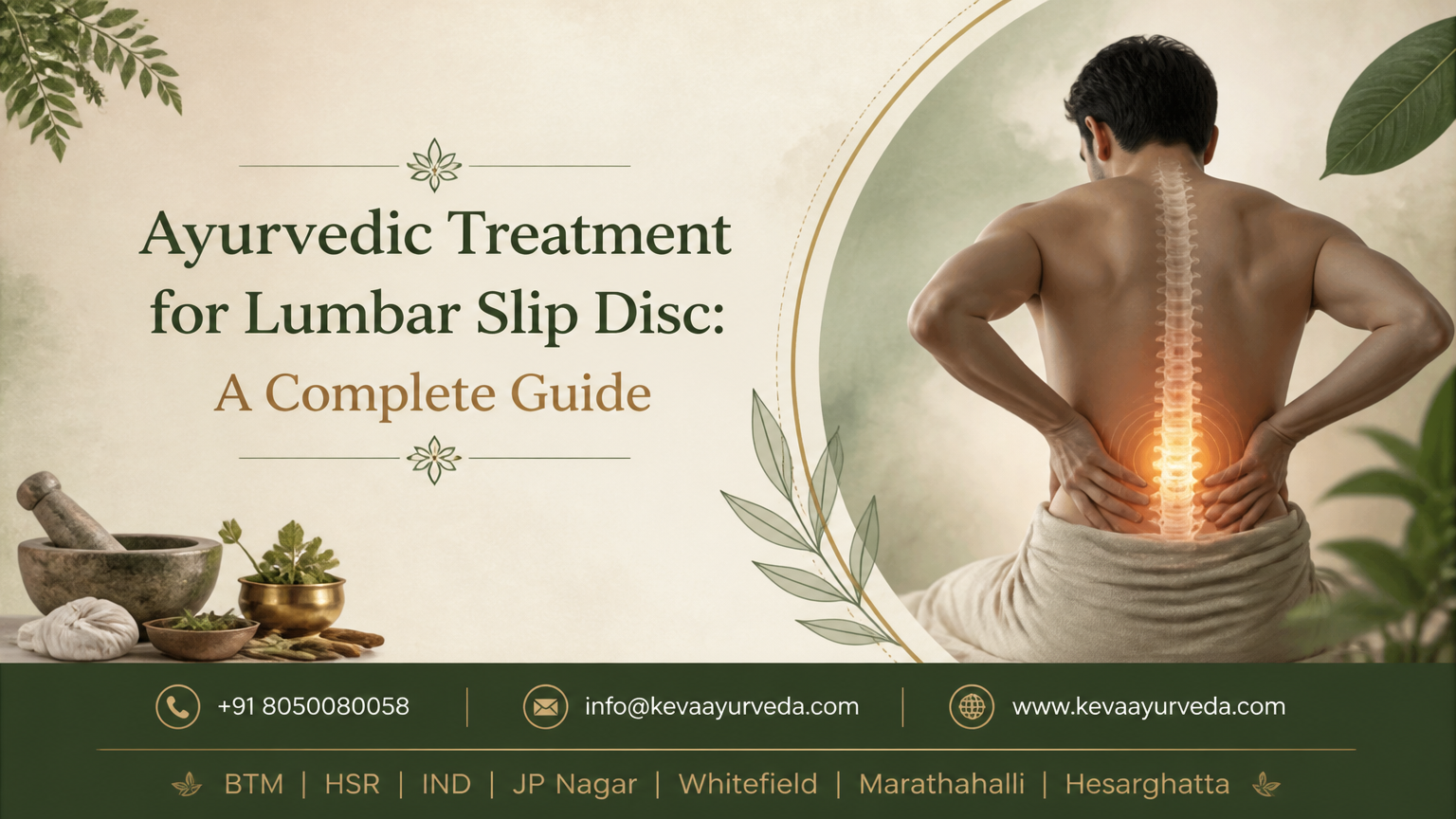
A nagging ache in your lower back that shoots down your leg — if that sounds familiar, you may be dealing with a lumbar slip disc. Globally, low back pain now affects over 619 million people, according to the World Health Organization, and slipped discs at the L4–L5 and L5–S1 levels are the most common structural cause. While surgery is often presented as the default path, a growing body of clinical evidence points to Ayurveda as a powerful, non-invasive alternative. This guide walks you through how Ayurveda understands lumbar disc herniation — known classically as Gridhrasi and Katishoola — and outlines the therapies, herbal medicines, diet, and yoga practices that can help you recover without going under the knife.
TL;DR / Quick Answer
Ayurvedic treatment for lumbar slip disc focuses on pacifying aggravated Vata through therapies like Kati Basti (warm medicated oil retention over the lower back), Panchakarma detox, herbal formulations, and targeted yoga. Recent Indian case studies show measurable disc reduction and functional recovery — even in post-surgical and extruded disc cases — making Ayurveda a credible non-surgical option worth exploring alongside your physician’s guidance.
Table of Contents
- What is Lumbar Slip Disc and How Ayurveda Views It
- Symptoms, Stages and Red-Flag Signs at L4-L5 and L5-S1
- Root Causes and Vata Aggravating Factors
- Ayurvedic Treatment Protocol: Kati Basti, Panchakarma and Herbal Medicines
- Evidence from Indian Clinical Studies on Ayurveda for Slip Disc
- Diet (Pathya-Apathya) and Lifestyle (Dinacharya) for Recovery
- Yoga Asanas and Home Exercises for Lumbar Slip Disc
- Recovery Timeline, Success Rate and When to Consider Surgery
What is Lumbar Slip Disc and How Ayurveda Views It (Katishoola & Gridhrasi)
A lumbar slip disc occurs when the soft, gel-like nucleus of an intervertebral disc in the lower spine pushes through its tough outer ring, pressing on nearby spinal nerves. This herniation most commonly affects the L4–L5 or L5–S1 segments and can trigger radiating leg pain (sciatica), numbness, and muscle weakness. Conventional medicine classifies the condition by severity — from mild bulges to extruded or sequestered fragments — and treatment ranges from physiotherapy and painkillers to discectomy surgery. The WHO Global Burden of Disease Study projects that low back pain cases will rise to 843 million by 2050, making it the world’s leading musculoskeletal disability.
In Ayurveda, a lumbar slip disc is understood through two classical frameworks: Katishoola (pain localized to the lower back) and Gridhrasi (sciatica, named after the vulture’s gait because the patient limps similarly). Both are classified as Vata Vyadhi — aggravated Vata dosha is the root pathological force. When Vata becomes vitiated through poor diet, excessive strain, aging, or suppression of natural urges, it dries out the Asthi Dhatu (bone tissue) and Majja Dhatu (marrow and nerve tissue), leading to disc degeneration and nerve compression. This understanding aligns well with modern pathophysiology: loss of disc hydration and annular tear. Clinics such as Keva Ayurveda leverage this root-cause framework to design individualized, non-surgical treatment plans targeting the underlying Vata imbalance rather than merely suppressing symptoms.
Symptoms, Stages and Red-Flag Signs at L4-L5 and L5-S1
The hallmark symptom of a lumbar slip disc is low back pain that radiates into the buttock, thigh, and below the knee — a pattern called sciatica or radiculopathy. At the L4–L5 level, patients often experience weakness in the big toe and difficulty lifting the foot (foot drop), while L5–S1 herniations typically cause pain along the back of the calf and sole of the foot with a diminished ankle reflex. Numbness, tingling, and a pins-and-needles sensation are common companion symptoms. The pain usually worsens with prolonged sitting, coughing, sneezing, or bending forward.
Ayurveda classifies symptom progression into stages that mirror modern grading. Mild disc bulging corresponds to initial Vata Prakopa (aggravation) with stiffness and intermittent ache. Moderate herniation presents with radiation into one leg — classical Gridhrasi — where the dominant dosha may be Vata alone or Vata-Kapha combined (the Kapha variant includes heaviness and swelling). Severe extrusion with bowel or bladder dysfunction is a red-flag emergency requiring immediate medical intervention. Any progressive muscle weakness, saddle-area numbness, or loss of bladder control warrants urgent neurological evaluation before considering conservative care. For patients in Bangalore and Mysore, booking a consultation with experienced Ayurvedic doctors can help determine whether a non-surgical Ayurvedic protocol is appropriate for your specific disc condition.
Root Causes and Vata Aggravating Factors
From a biomechanical perspective, lumbar disc herniation results from a combination of age-related degeneration, repetitive spinal loading, poor posture, and acute injury. As we age, discs lose water content and become less resilient — a process Ayurveda correlates directly with the natural increase of Vata dosha after age 50 (Vata Kala). Sedentary desk jobs, obesity, smoking, and chronic psychological stress accelerate disc degeneration. Occupational factors — heavy lifting with poor mechanics, repetitive twisting, and prolonged driving — are major modern contributors.
Ayurveda identifies several specific Vata-aggravating causes beyond general aging. Excessive intake of dry, cold, and light foods — such as raw salads, chips, and carbonated drinks — depletes Kapha’s unctuous quality, allowing Vata to dominate the musculoskeletal system. Suppression of natural urges (Vega Dharana), particularly the urge to defecate, creates abdominal pressure that transmits to the lumbar spine. Irregular sleep patterns, prolonged fasting, excessive travel, and emotional grief or anxiety are also classical Vata Prakopa triggers. Understanding these dual biomechanical and Ayurvedic causative factors is critical because effective treatment must address both. A comprehensive programme at an accredited facility like Spine & Joint Care at Keva Ayurveda integrates external therapies, internal medicines, diet correction, and lifestyle modification into a single protocol.
Ayurvedic Treatment Protocol: Kati Basti, Panchakarma and Herbal Medicines
The cornerstone of Ayurvedic treatment for lumbar slip disc is Kati Basti — a localized therapy in which a dam of black gram flour is built over the lumbar spine and filled with warm medicated oil (typically Bala Taila, Mahanarayana Taila, or Ksheerabala Taila). The oil is retained for 30–45 minutes, allowing deep penetration into disc and surrounding tissues. This warmth reduces Vata, lubricates intervertebral joints, nourishes degenerated disc tissue, and eases nerve compression. Kati Basti is typically prescribed in courses of 7–14 sessions, preceded by Sarvanga Abhyanga (full-body oil massage) and Swedana (steam therapy). A 2024 randomized controlled trial published in PubMed Central confirmed that yoga combined with add-on Kati Basti produced significantly greater pain reduction in chronic low back pain than yoga alone. Patients exploring Panchakarma Treatment will find Kati Basti among the most frequently recommended therapies for spine conditions.
Beyond Kati Basti, a full Panchakarma protocol for Gridhrasi includes Basti (medicated enema) — the single most important Vata-balancing therapy in Ayurveda. Matra Basti (daily oil enema) or Asthapana Basti (decoction enema) with Dashamoola Kwatha or Eranda Taila is administered over 8–16 days to pacify Vata at its root site in the colon. Internal herbal medicines complement external therapies: Yograj Guggulu and Shallaki (Boswellia serrata) reduce inflammation; Rasnasaptakam Kwatha and Trayodashang Guggulu address nerve pain and stiffness; Ashwagandha and Bala support tissue repair. Dosage and combination must always be individualized by a qualified Ayurvedic physician based on the patient’s Prakriti, Vikriti, and disc severity. Panchakarma requires thorough medical assessment, and outcomes vary from patient to patient.
Evidence from Indian Clinical Studies on Ayurveda for Slip Disc
Indian clinical research over the past two years has strengthened the evidence base for Ayurvedic management of lumbar disc herniation considerably. A 2025 case report published in the Journal of Ayurveda and Integrative Medicine (Elsevier) documented a 45-year-old woman with recurrent lumbar radiculopathy six months after spinal fusion surgery (TLIF). A 43-day Ayurvedic regimen combining Trayodashang Guggulu, Dashmool Kwatha, Sarvanga Abhyanga-Mardana, and Swedana reduced her Oswestry Disability Index and Visual Analogue Scale scores significantly while her walking distance improved from 80 metres to over 1,000 metres with no adverse effects.
Even more striking, a 2025 case study in the International Journal of Ayurveda Research (Wolters Kluwer) reported significant resolution of a 10 × 8 mm migrated L5–S1 disc extrusion — a condition typically requiring emergency surgery. A 36-year-old wheelchair-bound man underwent Panchakarma, Kati Basti, Matra Basti, and oral medications at KLE Ayurveda College, Belagavi. Post-treatment MRI showed measurable reduction in disc extrusion and neurological compression, alongside dramatic functional recovery. Additionally, the Clinical Trials Registry of India (ICMR) lists an ongoing trial (CTRI/2024/02/062760) evaluating Shampakadi Asthapana Vasti, Kati Vasti, and Rasna Erandadi Kashayam for lumbar disc bulge. These findings do not mean Ayurveda replaces surgery in every case, but they demonstrate that classical Vata-pacifying protocols can deliver measurable clinical improvement — including radiological disc changes — in patients who either cannot undergo or have not responded to conventional surgery.
Diet (Pathya-Apathya) and Lifestyle (Dinacharya) for Recovery
Ayurvedic recovery from lumbar slip disc is incomplete without dietary and lifestyle correction — a concept called Pathya-Apathya (wholesome and unwholesome regimen). Since the underlying pathology is Vata aggravation, the diet must counterbalance Vata’s dry, cold, and light qualities with warm, moist, and nourishing foods. Pathya (recommended) foods include warm milk with turmeric, ghee, old rice, mung dal, soups with cumin and ginger, sesame oil, and cooked root vegetables like sweet potato and beetroot. Apathya (foods to avoid) include cold salads, raw vegetables, dry crackers, frozen meals, excessive caffeine, alcohol, carbonated drinks, and stale or reheated food. Incompatible food combinations (Viruddha Ahara) — such as milk with sour fruits — should also be strictly avoided.
Lifestyle adjustments follow the principles of Dinacharya (daily routine). Waking before 6:00 AM, performing gentle oil self-massage (Abhyanga) with sesame or Dhanwantharam Taila, and maintaining regular bowel habits are foundational practices. Prolonged sitting should be broken every 30–40 minutes with a standing stretch. Sleeping on a firm mattress on the back or side with a pillow under the knees reduces lumbar pressure. Emotional regulation is equally important — chronic stress and anxiety increase cortisol, worsening Vata and delaying tissue healing. Pranayama techniques like Nadi Shodhana and Bhramari help calm the nervous system. For deeper guidance on integrating Ayurvedic habits into daily life, the Keva Ayurveda Health Blog offers regular articles on lifestyle practices tailored to specific conditions.
Yoga Asanas and Home Exercises for Lumbar Slip Disc
Yoga is increasingly recognized as an evidence-based adjunct therapy for lumbar disc herniation. A systematic approach focuses on gentle spinal decompression, core strengthening, and hamstring flexibility — all critical for reducing intradiscal pressure. Safe asanas for lumbar slip disc include Bhujangasana (Cobra Pose) for gentle spinal extension, Marjariasana-Bitilasana (Cat-Cow) for mobilization, Setu Bandhasana (Bridge Pose) for glute and core activation, and Supta Matsyendrasana (Supine Spinal Twist) for gentle rotation. Shavasana with knees elevated is the preferred resting position. Patients should avoid deep forward bends like Paschimottanasana, full inversions, and any posture that triggers sharp radiating pain.
The 2024 randomized controlled trial published in PubMed Central specifically examined yoga combined with Kati Basti for chronic low back pain, finding that the combined intervention outperformed yoga alone in reducing pain severity and disability scores. This supports the Ayurvedic principle that external therapies and internal movement practices work synergistically. Home exercises recommended between therapy sessions include pelvic tilts, knee-to-chest stretches, sciatic nerve gliding (flossing), and walking on flat ground for 20–30 minutes daily. Patients with acute, severe pain or neurological deficits should begin yoga only after initial Panchakarma therapy has reduced inflammation — typically after the first 5–7 days of Kati Basti. A qualified physician can customize the sequence based on disc level, symptom severity, and Prakriti. Always stop any exercise that increases leg pain or numbness.
Recovery Timeline, Success Rate and When to Consider Surgery
One of the most common questions patients ask is how long recovery will take. The answer depends on disc severity, chronicity, and adherence to the full protocol. For mild to moderate disc bulges, a typical Ayurvedic programme runs 14–21 days of intensive Panchakarma therapy (outpatient or inpatient), followed by 2–3 months of internal medicines, diet, and yoga at home. Significant pain reduction is often reported within the first week, while functional recovery — the ability to sit, walk, and work comfortably — usually improves within 3–6 weeks. For larger extrusions or post-surgical cases, the timeline extends to 3–6 months. Patient success stories from experienced Ayurvedic clinics show consistent improvements in disability scores, though individual results vary.
However, Ayurveda is not a universal replacement for surgery. Red-flag situations demanding urgent surgical consultation include cauda equina syndrome (loss of bladder/bowel control), progressive motor weakness (such as worsening foot drop), and failure to improve after 6–8 weeks of structured conservative care. In such cases, delaying surgery can cause permanent nerve damage. The goal of Ayurvedic treatment is to help as many patients as possible avoid unnecessary surgery — not to oppose surgery when it is genuinely indicated. For those seeking a qualified, NABH-accredited assessment, booking a consultation with an experienced Ayurvedic team ensures your condition is evaluated thoroughly before a treatment plan is designed.
Conclusion
Lumbar slip disc is a painful, often debilitating condition — but it does not always require surgery. Ayurveda offers a structured, root-cause approach through Kati Basti, Panchakarma, herbal medicines, diet correction, and yoga that addresses the underlying Vata imbalance driving disc degeneration and nerve compression. Recent Indian clinical studies provide encouraging evidence, including measurable disc resolution and functional recovery even in complex post-surgical and extruded cases. The key is early intervention, physician-guided treatment, and patient commitment to lifestyle change. If you are struggling with persistent lower back pain or sciatica, exploring Ayurvedic care at a qualified facility like Keva Ayurveda could be the turning point in your recovery journey.
Frequently Asked Questions
What is Ayurvedic treatment for lumbar slip disc?
Ayurvedic treatment for lumbar slip disc involves Panchakarma therapies (especially Kati Basti and Basti), herbal medicines like Yograj Guggulu and Shallaki, dietary modifications, and yoga — all aimed at pacifying aggravated Vata dosha and restoring disc health without surgery.
How does Kati Basti help with a slipped disc?
Kati Basti involves retaining warm medicated oil over the lumbar spine for 30–45 minutes. The heat and herbal properties penetrate deep tissues, reducing inflammation, nourishing the disc, easing nerve compression, and lubricating spinal joints.
Can a large disc extrusion heal without surgery?
Recent Indian case studies show that even large migrated disc extrusions (up to 10 × 8 mm) have shown measurable reduction with classical Panchakarma protocols. However, results vary and physician evaluation is essential before choosing any treatment path.
How long does Ayurvedic treatment take for a lumbar slip disc?
Intensive Panchakarma therapy typically runs 14–21 days, followed by 2–3 months of oral medicines, diet, and yoga. Complex or post-surgical cases may take 3–6 months for full functional recovery.
Is Ayurveda safe for slip disc during pregnancy?
Ayurvedic therapies require significant modification during pregnancy. Many Panchakarma procedures are contraindicated. Pregnant patients should consult both their obstetrician and a qualified Ayurvedic physician before beginning any treatment.
When should I consider surgery instead of Ayurveda for slip disc?
Surgery should be considered urgently if you have cauda equina syndrome (bladder or bowel dysfunction), progressive muscle weakness, or if 6–8 weeks of structured conservative care fails to improve symptoms significantly.
What foods should I avoid with a lumbar slip disc?
Avoid cold, dry, and light foods — raw salads, chips, carbonated drinks, excessive caffeine, and alcohol — that aggravate Vata. Prefer warm, moist, nourishing foods like ghee, soups, cooked vegetables, and turmeric milk.
Can yoga worsen a slipped disc?
Certain poses — deep forward bends, heavy backbends, and inversions — can worsen a slip disc. Always practice under qualified guidance, stop any pose that increases leg pain, and begin yoga only after initial inflammation has subsided.