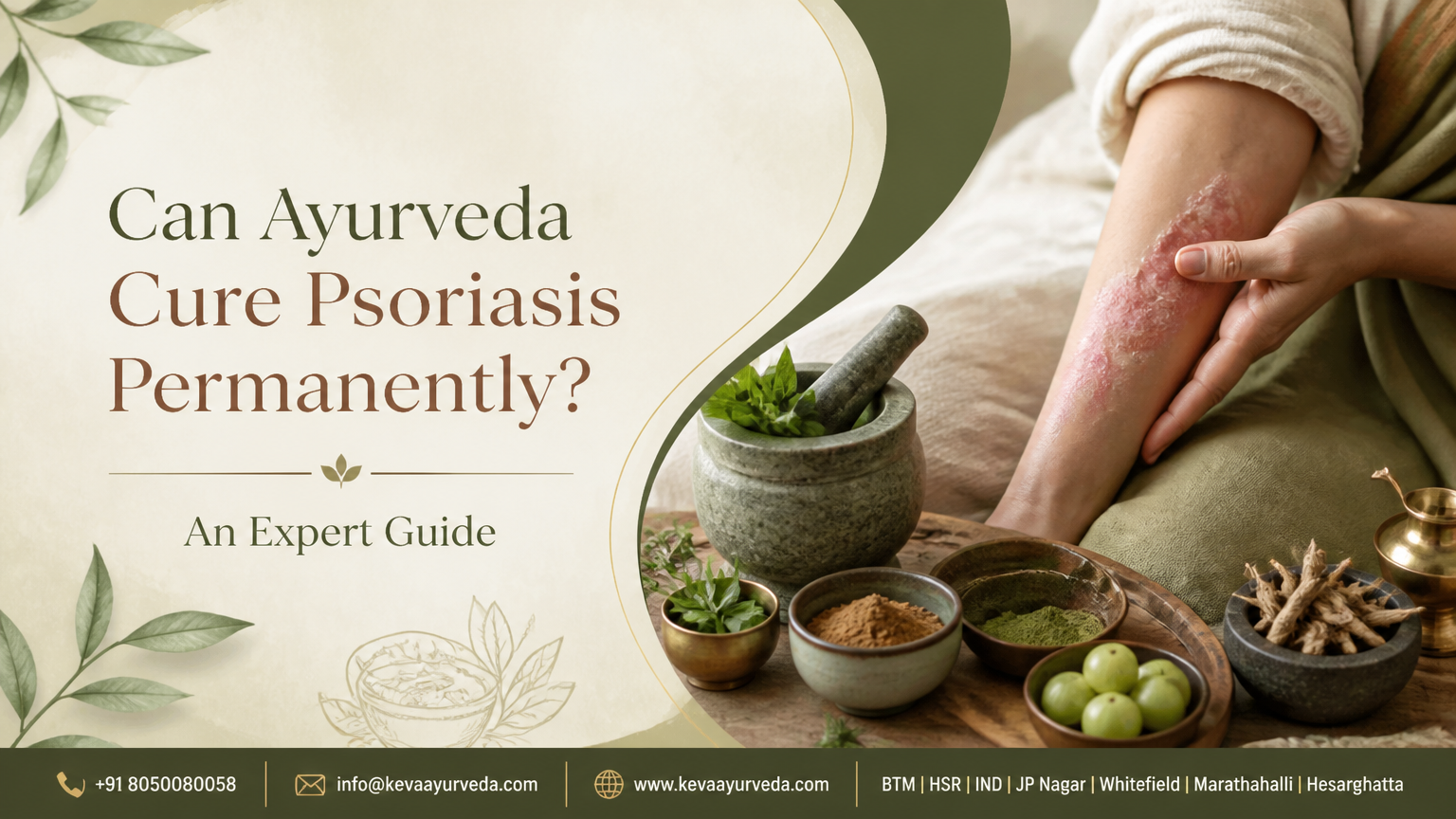
Can Ayurveda Cure Psoriasis Permanently? An Expert Guide (2026)
Psoriasis now affects over 43 million people worldwide, and India is no exception. If you are searching for answers about whether can Ayurveda cure psoriasis permanently, you are not alone — this is one of the most common questions skin specialists hear every week. Conventional treatments such as steroids and biologics often manage flare-ups but rarely address the underlying cause, leaving patients searching for safer, longer-term solutions. Ayurveda approaches psoriasis as a systemic imbalance rather than a skin-only problem, using herbal medicines, Panchakarma detox therapies, dietary corrections and daily routine changes. This expert guide examines the clinical evidence behind Ayurvedic psoriasis care, the realistic timelines involved, and what you can genuinely expect from authentic, supervised treatment in 2026.
TL;DR / Quick Answer
Ayurveda does not promise a permanent cure for psoriasis, which is a chronic, relapsing-remitting autoimmune condition. However, evidence-based Ayurvedic protocols — especially Vamana, Virechana and Rasayana therapy — can produce multi-year remission, with government clinical trials reporting PASI score reductions of around 78%. Long-term success depends on trigger management and strict dietary adherence.
Table of Contents
- Understanding Psoriasis Through the Ayurvedic Lens
- Can Ayurveda Cure Psoriasis Permanently? The Honest Answer
- The Ayurvedic Root-Cause Framework: Doshas, Agni and Ama
- Panchakarma Therapy for Psoriasis: Clinical Evidence
- Key Herbs, Diet and Daily Routine (Dinacharya) for Psoriasis
- Realistic Timelines, Relapse Triggers and Long-Term Management
- Choosing the Right Ayurvedic Clinic for Psoriasis Care
- Frequently Asked Questions
Understanding Psoriasis Through the Ayurvedic Lens
Psoriasis is described in classical Ayurvedic texts under several headings, the most common being Ekakushta and Kitibha, both characterized by well-demarcated, scaly, silvery-white plaques. According to Ayurveda, the disease originates not on the surface but deep within the body’s physiology, primarily through an imbalance of Vata and Kapha doshas along with vitiated Pitta and the Rakta (blood) dhatu. Modern dermatology classifies psoriasis as a chronic, immune-mediated inflammatory skin disorder with a strong genetic component, and a 2025 Global Burden of Disease analysis published in Frontiers in Public Health confirms that global cases have surged 86% since 1990 — reaching 42.98 million by 2021. India contributes significantly to this burden, particularly in urban, high-stress populations.
From an Ayurvedic standpoint, poor digestion (weak Agni) leads to the formation of Ama (metabolic toxins), which travels through the bloodstream and accumulates in the skin layers. Triggers such as stress, alcohol, smoking, incompatible food combinations, and erratic routines aggravate the doshas and re-ignite flare-ups. Recognized Ayurvedic institutions like Keva Ayurveda – NABH Accredited Ayurveda Clinic in Bangalore evaluate these root-cause patterns before prescribing any herbal formulation or detox therapy. Understanding this dosha-dhatu framework is the first step toward asking the deeper question: can Ayurveda cure psoriasis permanently, or at least help patients live symptom-free for years at a time?
Can Ayurveda Cure Psoriasis Permanently? The Honest Answer
The honest, evidence-aligned answer is that Ayurveda does not claim a guaranteed permanent cure for psoriasis. Psoriasis is classified as an autoimmune, relapsing-remitting condition in both modern dermatology and Ayurveda, meaning genetic predisposition cannot be erased. However, Ayurveda has consistently demonstrated the ability to induce long-term remission lasting 2 to 5 years or more when treatment is rigorous and followed by disciplined lifestyle maintenance.
A 2025 case report indexed on PubMed Central documented a patient who maintained zero active lesions (PASI 0) for over three years with strict dietary adherence after comprehensive Ayurvedic intervention. Another 2026 longitudinal case report in Frontiers in Medicine tracked a chronic plaque psoriasis patient whose PASI score dropped from 52 to 6 after staged Shodhana therapy, sustained near-complete remission for roughly two years, and then experienced a mild stress-triggered relapse (PASI 12) in April 2026 — which again responded to a second Ayurvedic cycle.
Government-backed research reinforces these outcomes. A prospective multicenter clinical study conducted by India’s Central Council for Research in Ayurvedic Sciences (CCRAS) evaluated 85 plaque psoriasis patients receiving Vamana Karma followed by Takradhara and Rasayana over 66 days. The mean PASI score dropped from 23.594 to 5.199 — a statistically significant 78% reduction — with marked improvements in Dermatology Life Quality Index scores and no adverse events. So when patients ask can Ayurveda cure psoriasis permanently, the clinically correct phrasing is: Ayurveda can deliver sustained, multi-year remission for the majority of well-selected, compliant patients, provided triggers are actively managed for life.
The Ayurvedic Root-Cause Framework: Doshas, Agni and Ama
Unlike topical creams that only suppress visible plaques, Ayurveda treats psoriasis by targeting the systemic imbalance that allows the disease to manifest. The classical framework involves three layers: aggravated doshas, impaired digestive fire (Agni), and accumulated metabolic toxins (Ama).
Vata dosha, when disturbed, causes the excessive dryness, scaling and itching characteristic of psoriatic plaques. Kapha dosha contributes the thickness, stickiness and silver-colored scales. Pitta dosha, often supported by vitiated Rakta dhatu, drives the inflammation, redness and burning sensation underneath. When Agni weakens, undigested food residue forms Ama, a sticky toxic substance that circulates through the Raktavaha Srotas (blood channels) and lodges in the skin. Treatment therefore follows two complementary principles: Shodhana (cleansing/detoxification) and Shamana (palliative care). Shodhana removes accumulated Ama and vitiated doshas from their root sites through Panchakarma procedures, while Shamana uses herbal formulations, diet and lifestyle measures to prevent re-accumulation. This is why Ayurvedic psoriasis management is not a one-time prescription but a phased protocol spanning several months. Practitioners like those at Keva Ayurveda, India’s first NABH-accredited Ayurveda clinic, conduct detailed dosha assessment, digestive evaluation and trigger analysis before tailoring any protocol — because identifying the patient’s specific doshic dominance is critical for lasting results.
Panchakarma Therapy for Psoriasis: Clinical Evidence
Panchakarma is the most evidence-supported Ayurvedic intervention for moderate to severe plaque psoriasis. The five classical Shodhana procedures — Vamana (therapeutic emesis), Virechana (purgation), Basti (medicated enema), Nasya (nasal therapy), and Raktamokshana (bloodletting) — are selectively prescribed based on the patient’s doshic picture.
The CCRAS multicenter clinical study cited earlier remains one of the most rigorous government evaluations. In 85 plaque psoriasis patients receiving Vamana followed by Takradhara (medicated buttermilk poured over the forehead) and Rasayana (rejuvenation) therapy, mean PASI scores fell from 23.594 at baseline to 5.199 at trial end, with significant Dermatology Life Quality Index improvement and normal liver and kidney function throughout. The 2026 Frontiers in Medicine longitudinal case further demonstrated that staged Shodhana — combining Vamana, Virechana and Basti — can take even severe cases (PASI 52) down to PASI 6, with near-complete remission sustained over two years.
For skin-specific detoxification, specialized protocols like Panchakarma treatment for skin detox incorporate external therapies such as Abhyanga (oil massage), Swedana (herbal steam), Lepam (medicated paste application) and Takradhara, alongside internal Shodhana. Inpatient Panchakarma typically runs 12 to 21 days under continuous medical supervision, with outpatient options available for milder cases. These clinical and observational outcomes are comparable to several modern systemic therapies — without the immunosuppression risks, hepatotoxicity concerns or long-term dependency associated with biologics and oral retinoids. For patients weighing safety and durability, Panchakarma represents the most credible Ayurvedic pathway to sustained remission.
Key Herbs, Diet and Daily Routine (Dinacharya) for Psoriasis
Ayurvedic psoriasis treatment typically combines internal herbal medicines with topical lepas and a carefully designed daily routine. The most commonly prescribed herbs include Bakuchi (Psoralea corylifolia) for skin rejuvenation, Khadira (Acacia catechu) and Neem (Azadirachta indica) for blood purification, Manjistha (Rubia cordifolia) for clearing the Raktavaha Srotas, Sariva (Hemidesmus indicus) for cooling inflammation, and Turmeric (Curcuma longa) for its well-studied anti-inflammatory action. Formulations such as Arogyavardhini, Gandhaka Rasayana and Panchatikta Ghrita Guggulu are typically prescribed under medical supervision only.
Diet is equally critical. Ayurveda recommends a sattvic, vegetarian, anti-inflammatory approach: warm cooked meals, bitter greens, mung dal, old rice, ghee, turmeric milk and adequate hydration. Patients are advised to avoid curd at night, fish with milk, excess salt, sour foods, fermented items, alcohol, smoking and processed sugar — all recognized psoriasis triggers. Eating at consistent times supports Agni recovery. Daily routine (Dinacharya) modifications include waking before sunrise, 15 to 20 minutes of gentle yoga or pranayama, medicated oil application before bathing, regular sleep, and stress management through meditation. For readers wanting deeper self-care guidance, read more Ayurveda health tips on our blog for seasonal routines and recipes tailored to skin conditions. These habits are not optional add-ons — they are the maintenance phase that protects remission for years.
Realistic Timelines, Relapse Triggers and Long-Term Management
Patients often ask how long Ayurvedic psoriasis treatment actually takes. Based on 2026 clinical practice and CCRAS protocols, a complete Shodhana phase typically runs 21 to 45 days in inpatient or outpatient settings, followed by a 2 to 4 month Shamana phase of herbal medicines, diet and lifestyle corrections. The CCRAS trial duration was 66 days for the intensive phase, with patients reporting meaningful improvement typically between weeks 4 and 8. Some chronic cases require 6 to 12 months for stable remission, especially when comorbidities like obesity, diabetes or PCOD coexist.
Relapse triggers are predictable and well documented. Emotional stress remains the single biggest driver, followed by dietary indiscretions (especially dairy, alcohol and night eating), seasonal changes (winter and monsoon flare-ups are common), infections, certain medications and sleep deprivation. The 2026 Frontiers longitudinal case illustrated this clearly — a patient in stable remission experienced a mild flare (PASI 12) during an intensely stressful period, which again responded to a second Ayurvedic cycle (PASI 5). This is the realistic picture: psoriasis can be controlled into long dormancy, but it is rarely erased forever.
Long-term success therefore depends on three habits: maintaining the prescribed sattvic diet even after remission, practicing daily stress management, and scheduling seasonal check-ups (typically before winter and monsoon) for preventive Panchakarma or Rasayana. Patients who treat Ayurveda as a lifestyle rather than a one-time course tend to enjoy the longest remissions. Those who return to old habits often see plaques return within 6 to 18 months. Honest Ayurvedic clinics emphasize this maintenance phase clearly rather than promising permanent cures.
Choosing the Right Ayurvedic Clinic for Psoriasis Care
Not all Ayurvedic clinics deliver the same outcomes for psoriasis, and choosing the wrong one can waste months and money. Three credentials matter most. First, look for NABH accreditation — the National Accreditation Board for Hospitals and Healthcare Providers evaluates clinics on safety, hygiene, doctor qualifications and protocol standardization. Keva Ayurveda is India’s first NABH-accredited Ayurveda company and the first to receive NABH Panchakarma accreditation, which is a meaningful differentiator for chronic skin conditions requiring inpatient detox.
Second, verify that consultations and Panchakarma are supervised by qualified BAMS (Bachelor of Ayurvedic Medicine and Surgery) doctors. Skin conditions like psoriasis need differential diagnosis to rule out eczema, fungal infections or drug-induced rashes before starting Shodhana. Reputed clinics such as About Keva Ayurveda – India’s first NABH accredited Ayurveda clinic document doctor credentials transparently, including founder Dr. Krishna Kumar and Chief Medical Officer Dr. Deepika M. Third, examine proof points — published patient testimonials, Practo and Google ratings, and ideally before-and-after case documentation. Keva Ayurveda holds a Practo rating of 4.5/5, has been awarded Best Ayurveda Clinic in Bangalore five years running, and operates branches across Bangalore (BTM, HSR, Indiranagar, Marathahalli, Whitefield, JP Nagar, Nagarbavi) plus Mysore, with online consultation available pan-India. For patients who want to verify real outcomes before committing, read real patient success stories directly on the clinic’s website. Choosing an authentic, accredited clinic dramatically improves both safety and the likelihood of multi-year remission.
Conclusion
So, can Ayurveda cure psoriasis permanently? Not in the absolute sense — psoriasis is a chronic autoimmune condition that may resurface under stress or trigger exposure, even after years of remission. What authentic, evidence-based Ayurveda can deliver is something equally valuable: sustained multi-year remission with dramatically improved quality of life, minimal side effects, and root-cause healing rather than lifelong symptom suppression. Government CCRAS trials confirm PASI reductions of nearly 78%, and longitudinal case reports document remissions lasting 2 to 3 years with disciplined follow-up. The honest path forward is choosing a NABH-accredited clinic with qualified BAMS doctors, committing to the full Panchakarma-plus-Shamana protocol, and adopting diet and lifestyle changes as a long-term practice rather than a temporary fix. Ready to begin? Book a consultation with our BAMS doctors or call +91-8050080058 to start your personalized Ayurvedic psoriasis treatment plan today.
Frequently Asked Questions
Can Ayurveda cure psoriasis permanently?
No treatment system can guarantee a permanent cure for psoriasis, as it is a chronic, relapsing-remitting autoimmune condition. However, Ayurveda can deliver sustained multi-year remission for the majority of compliant patients, with government CCRAS trials showing PASI reductions of approximately 78%.
What is the success rate of Ayurvedic treatment for psoriasis?
Government-backed CCRAS clinical trials show approximately 78% PASI score reduction in plaque psoriasis patients receiving Vamana plus Rasayana therapy. Real-world outcomes vary by adherence, disease severity and trigger management, but well-selected patients commonly achieve multi-year remission.
How long does Ayurvedic treatment take for psoriasis?
Intensive Panchakarma typically runs 21 to 45 days, followed by 2 to 4 months of Shamana therapy with herbal medicines and dietary correction. Chronic or severe cases may require 6 to 12 months for stable remission.
Is Ayurvedic treatment safe for chronic plaque psoriasis?
Yes, when supervised by qualified BAMS doctors. The CCRAS trial reported no adverse events, with liver and kidney function tests remaining within normal limits throughout treatment. Self-medication or unqualified practitioners carry higher risk.
Can psoriasis come back after Ayurvedic treatment?
Yes, relapses can occur under stress, dietary indiscretions, seasonal changes or infections — psoriasis is fundamentally a relapsing-remitting condition. Maintenance through diet, Dinacharya and seasonal Panchakarma significantly extends remission duration.
Is Panchakarma necessary for psoriasis, or can herbs alone work?
Mild cases may respond to Shamana herbs and lifestyle changes alone. Moderate to severe plaque psoriasis typically requires Panchakarma (especially Vamana or Virechana) to remove accumulated Ama and vitiated doshas from their root before herbal medicines can work effectively.
Can I continue allopathic medicines alongside Ayurveda?
Yes, in most cases. Reputed Ayurvedic clinics coordinate with dermatologists for a transition phase, gradually tapering steroids or immunosuppressants under medical supervision as Ayurvedic treatment takes effect. Never discontinue prescribed medication abruptly.
Is online Ayurvedic consultation effective for psoriasis?
Online consultation works well for initial assessment, follow-ups and Shamana-phase prescriptions with pan-India medicine delivery. Inpatient Panchakarma, however, requires in-clinic visits for supervised therapies like Vamana, Virechana and Takradhara.